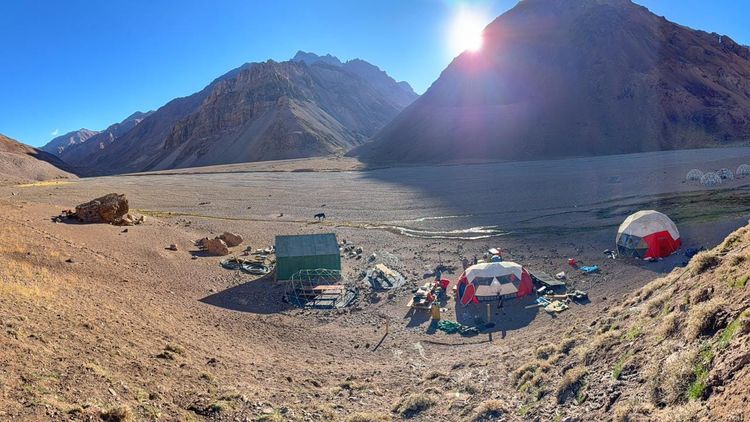
Camp 1 Route 360 Aconcagua: Complete Guide to the First High Camp
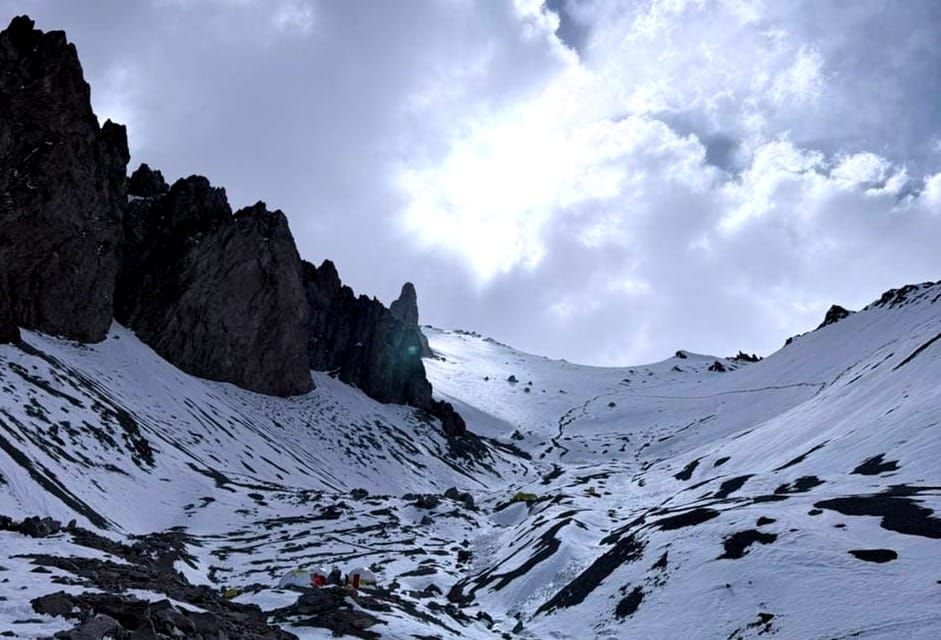
For mountaineers looking for a wilder and more scenic experience on the colossus of America, the 360° Route (or Vacas Traverse) represents the perfect option. Camp 1 is the first strategic step in this high-altitude ascent, a key point whether your final goal is the normal traverse or if you are looking for the technical challenge of the Polish Glacier.
Below, I present the technical, logistical guide and guide secrets to master this stretch of the itinerary.
| Parameter | Technical Detail |
|---|---|
| Camp Name | Camp 1 (360° Route / Polish Glacier) |
| Official Altitude | 5,000 m / 16,404 ft |
| Approximate GPS Location | East Slope, above Plaza Argentina, Aconcagua Provincial Park |
| Distance from Base | Approx. 5.2 km from Plaza Argentina |
| Average Ascent Time | 4 to 6 hours |
| Next Linked Milestone | Aconcagua/Ameghino Pass (5,200 m / 17,060 ft) |
Introduction: The Portal to the East Face of Aconcagua
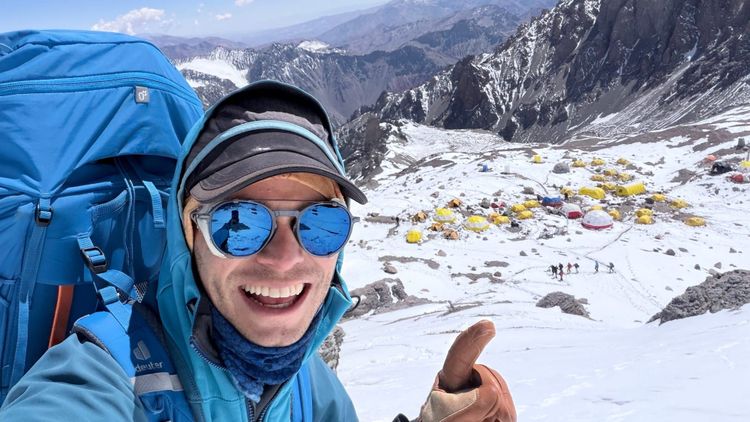
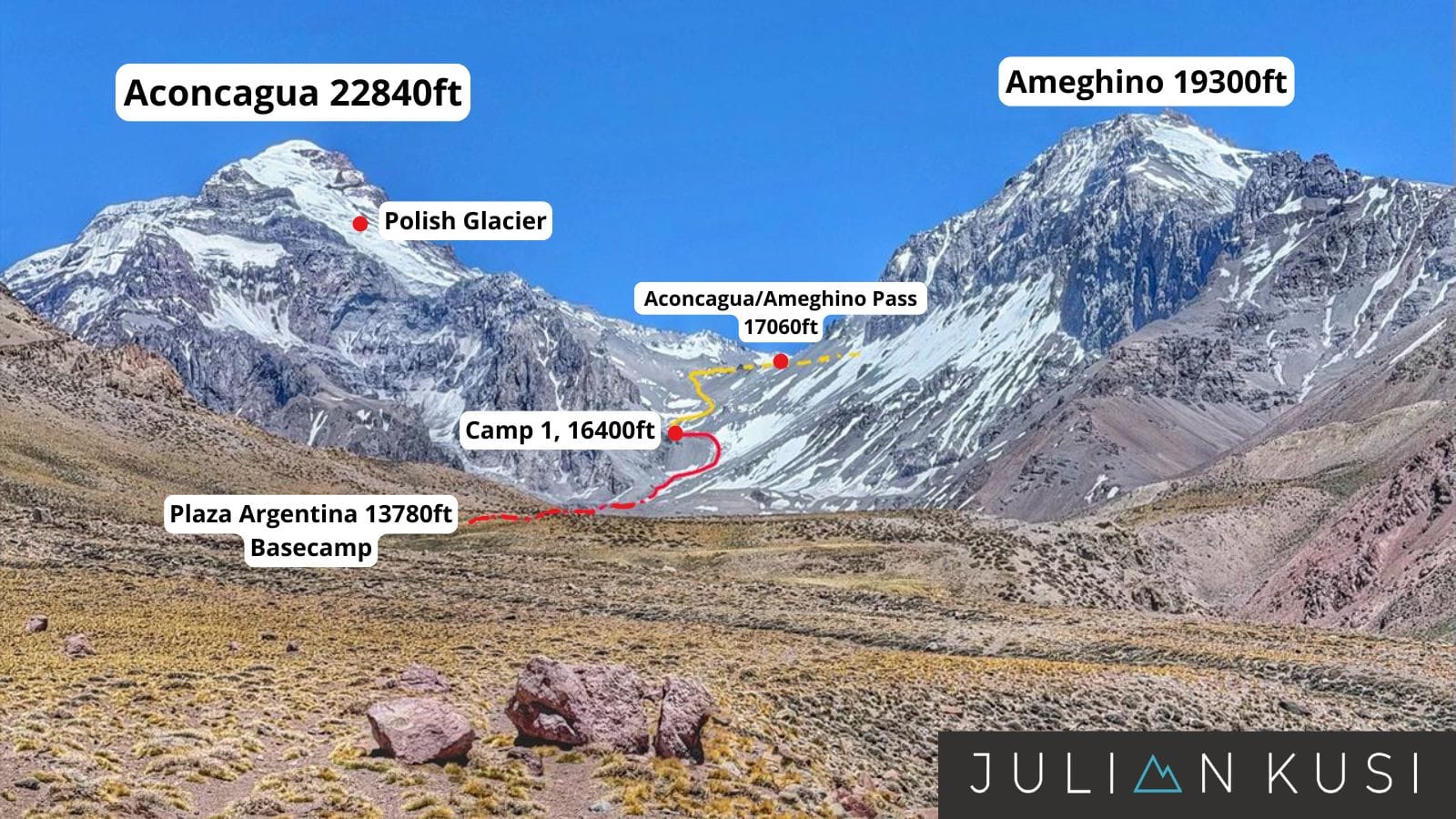
Leaving behind the Plaza Argentina base camp means entering true high-mountain terrain. The path to Camp 1 at 5,000 meters (16,404 ft) is visually stunning. Right from the approach through the Quebrada de los Relinchos, a breathtaking panoramic view opens up before your eyes: the imposing figure of Aconcagua flanked by Mount Ameghino. From there, you can trace with your eyes the route of the Aconcagua-Ameghino pass, the bergschrunds of the mystical Polish Glacier, and the exact location of Camp 1.
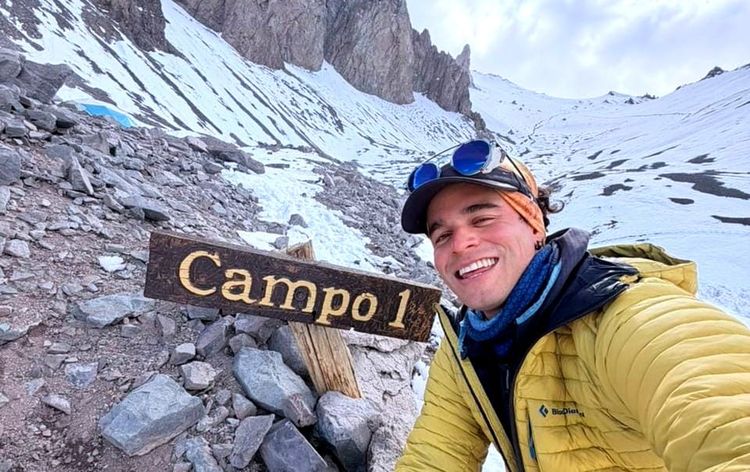
This camp acts as a mandatory strategic link. Whether your plan is to continue along the normal 360° Traverse route or detour toward Camp 2 to climb the demanding icy wall of the Polish Glacier, spending the night at this point is essential for your acclimatization process.
Route Logistics: From Base Camp to Camp 1
Terrain and Safety in the Initial Section
The march from the base camp takes place over glacial moraine terrain characterized by small but visible crevasses. The greatest danger in this first section lies in the instability of the terrain; the use of a technical helmet is mandatory due to the constant risk of rockfall in the narrow passages.
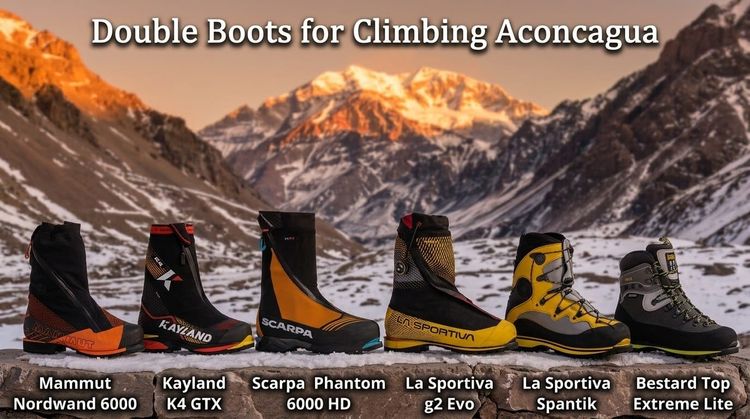
At the end of the journey, just before reaching the terraces of Camp 1, the trail becomes steep and runs through an area of loose rock (scree) mixed with night-frozen snow. Depending on the weather conditions of the day, it can be overcome just by using double boots or, if the surface presents hard ice, it will be strictly necessary to put on crampons.
Night Management and Portaging Strategy
The first time you step onto Camp 1 will be during the day of portaging gear and food from the base camp. Once you begin the final ascent with all your equipment, the overnight strategy varies:
- 1-Night Strategy (Recommended): If you have the opportunity to hire an official park porter for your heavy loads, or if you are in excellent physical condition to carry all your gear on your own in one go, the ideal option is to spend only one night here and continue advancing.
- 2-Night Strategy: You spend two nights at Camp 1 when you decide to do your own carry/portage ahead to Camp 2 (Guanacos Camp 3). This breaks up the effort and protects your altitude adaptation.
Map camp 1, Aconcagua Route 360
Strategic Comparison: Camp 1 (360° Route vs. Normal Route)
Analyzing the geographical advantages of this camp compared to its counterpart on the Normal Route (Plaza de Canadá) allows for optimizing the expedition's energy:
- The Running Water Advantage: In this Camp 1 of the 360° route, it is extremely easy to get liquid water running on the surface during sunny hours. This represents a huge benefit compared to Canadá on the normal route, where melting snow consumes valuable fuel, time, and effort.
- The Early Sun Advantage: Being positioned on the eastern slope, the sun hits Camp 1 of the 360° Route at 7:00 am, allowing you to pack up camp and hydrate much earlier. In contrast, on the Normal Route, the sun usually doesn't appear until 9:00 am due to the shadow cast by the mountain itself.
- The Common Factor: Limited Space. Both camps share a critical disadvantage: they have very little flat space available to pitch high-altitude tents. It is not a comfortable site to spend several days, so the technical recommendation is to move the logistics toward Camp 3 (Guanacos) as soon as possible.
The Adjacent Challenge: The Portezuelo and the Polish Glacier
Very close to the camp, at 5,200 meters (17,060 ft), lies the Portezuelo or Col Aconcagua/Ameghino. This col is a geographical turning point: it is an indispensable part of the route whether you are going to Guanacos 3 (Camp 2 of the normal 360° traverse) or going to Camp 2 to later climb the Polish Glacier or do the False Polish route.
A Historic Route in Mountaineering
Named in honor of the famous Polish expedition that opened the line in 1934, the Polish Glacier is one of the most classic, aesthetic, and demanding high-altitude climbs in the Andes Mountain Range. It is technically classified as Difficult (D). Here, the progression is no longer high-altitude trekking; it demands absolute mastery of crampons, a technical/mountaineering ice axe, and traveling through sections equipped with fixed ropes.
The glacier proper begins at 6,000 meters (19,685 ft) and exposes sustained slopes ranging between 45° and 60° of inclination in its most critical and technical section, popularly known as "the funnel" (el embudo). Those who choose this route make their approach through the Quebrada de Vacas to Plaza Argentina, spend the night at Camp 1, and, after overcoming the glacier, make a safety descent via the Normal Route, crossing Plaza de Mulas to exit through the Horcones entrance.
Remember that high-altitude evacuation insurance is mandatory to obtain your permit. I fully trust Global Rescue, and it is the one I recommend to my clients for its proven response in the high mountains.
 Julian Kusi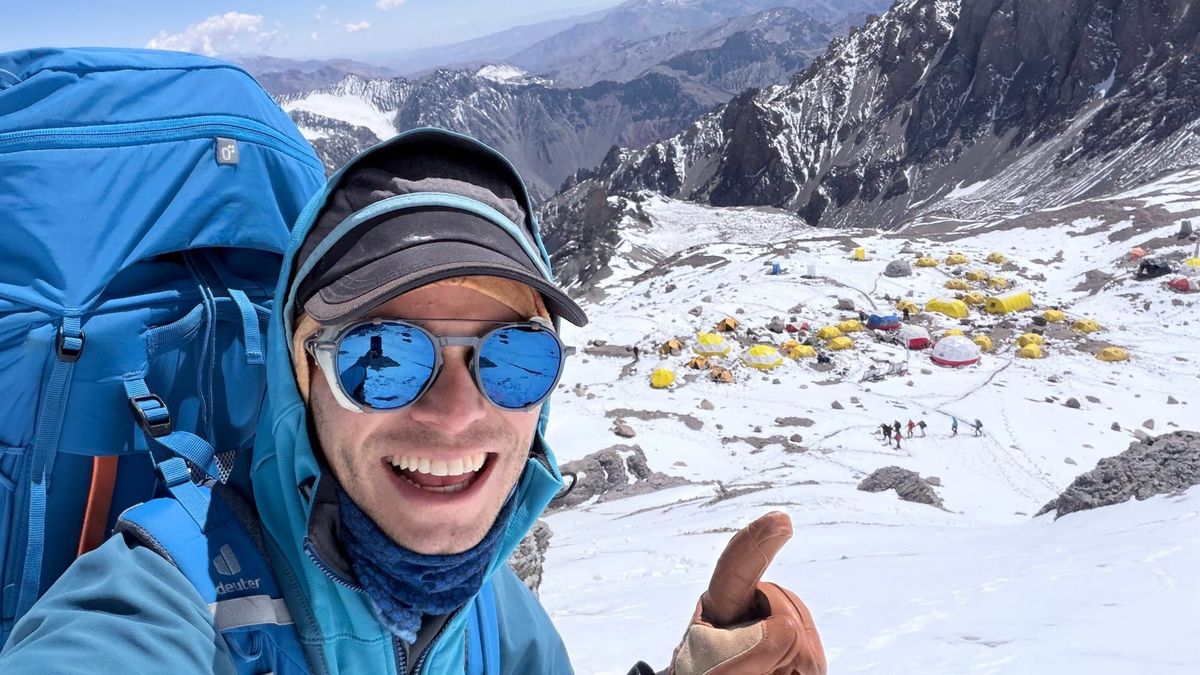
Next camp of this 360 Route
Remember that high-altitude evacuation insurance is mandatory to obtain your permit. I have complete confidence in Global Rescue and recommend them to my clients because of their proven track record in high-altitude situations.
Are you ready for Aconcagua?
Don't leave your expedition to chance. The mountain demands planning and the guidance of professionals who know its secrets. You can contact me directly for personalized advice through my official website.
About the author
Julián Kusi is a professional mountain guide with 17 summits on the "Stone Sentinel." Based in Mendoza, he specializes in the technical logistics and safety of the Normal and 360 routes on Aconcagua.
With a distinctly international and bilingual profile, Julián offers advice in Spanish, English, and Mandarin Chinese, facilitating access to the mountains for expeditions from around the world. His approach combines the precision of a high-altitude expert with modern logistical management, focused on maximizing the chances of reaching the summit for your next expedition.
Are you planning your next challenge? Connect with Julián for personalized advice and expedition availability on his Instagram: @julian_kusi or directly through aconcagua.co.