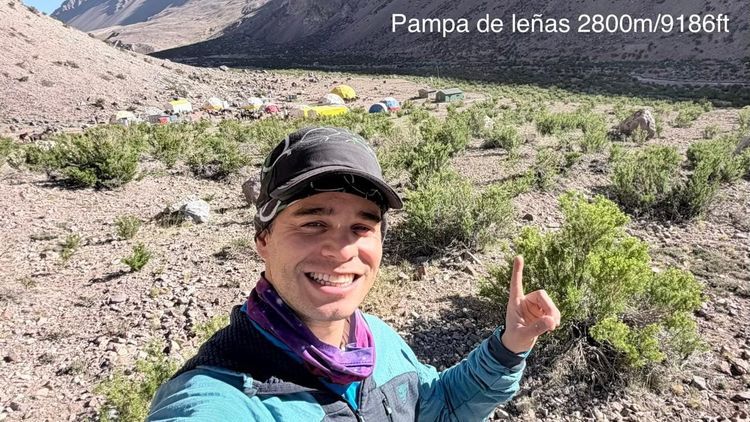
What are the boots for climbing Aconcagua?
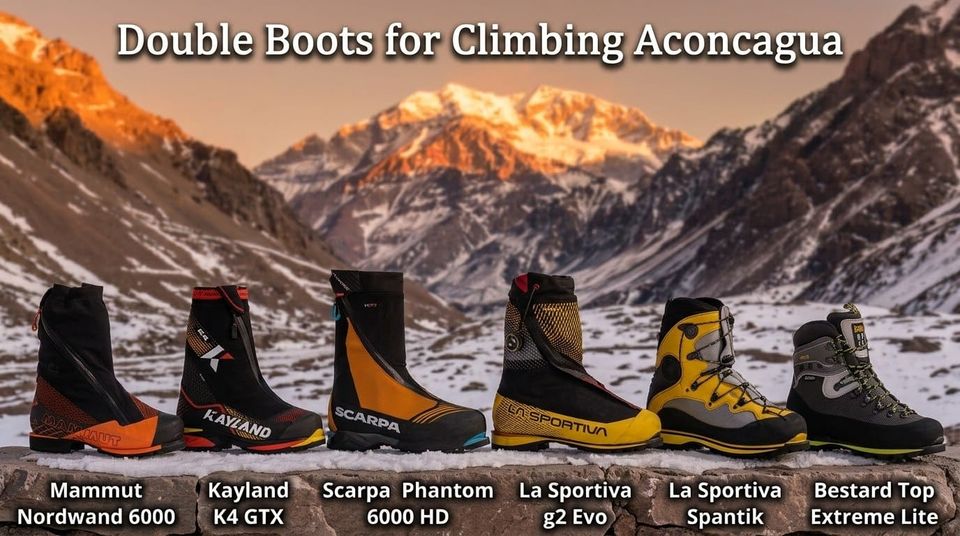
This is one of the most important topics and the one that generates the most questions when preparing to climb Aconcagua. That’s why I want to explain this as simply and detailed as possible, drawing from all my personal experience guiding in Aconcagua Provincial Park over the past few years. So, let’s get into it...
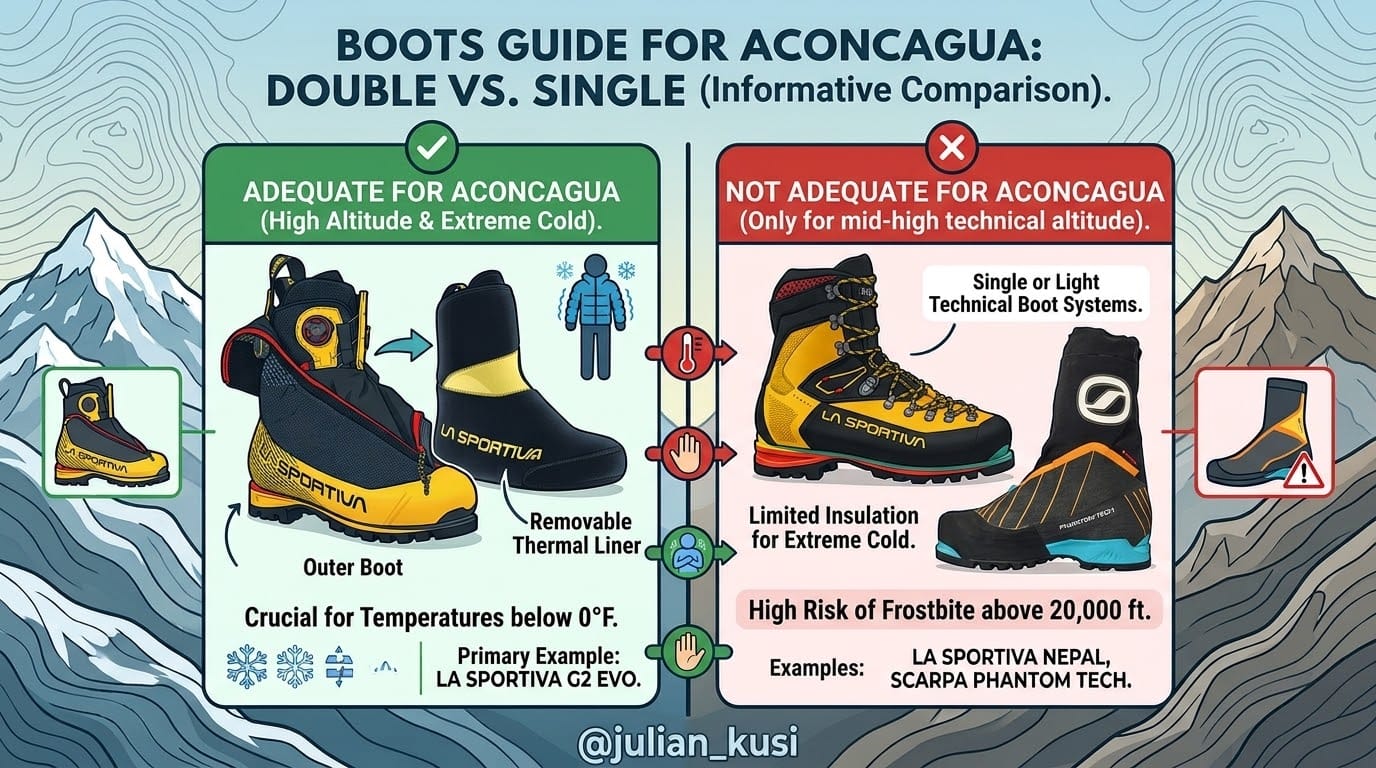
To begin with, it's essential to define what a double mountaineering boot is and not confuse it with a single boot. Although single boots are great for ice climbing and mountains between 13,100 and 16,400 feet, they do not have a removable inner bootie, so they are not considered double boots. Examples of single boots include the La Sportiva Nepal or the Scarpa Tech.
The design of a double boot features an outer shell and a removable inner liner (or bootie) to provide maximum thermal insulation. Additionally, they typically have toe and heel welts to accommodate fully automatic crampons, so it's crucial to verify that these welts are in good condition if you are buying them second-hand.
When buying them, it is absolutely essential to try them on in person. You should choose a pair between 1 and 1.5 European sizes larger than your everyday street shoes. When trying them on, make sure to wear the exact socks you plan to use on summit day—preferably merino wool.
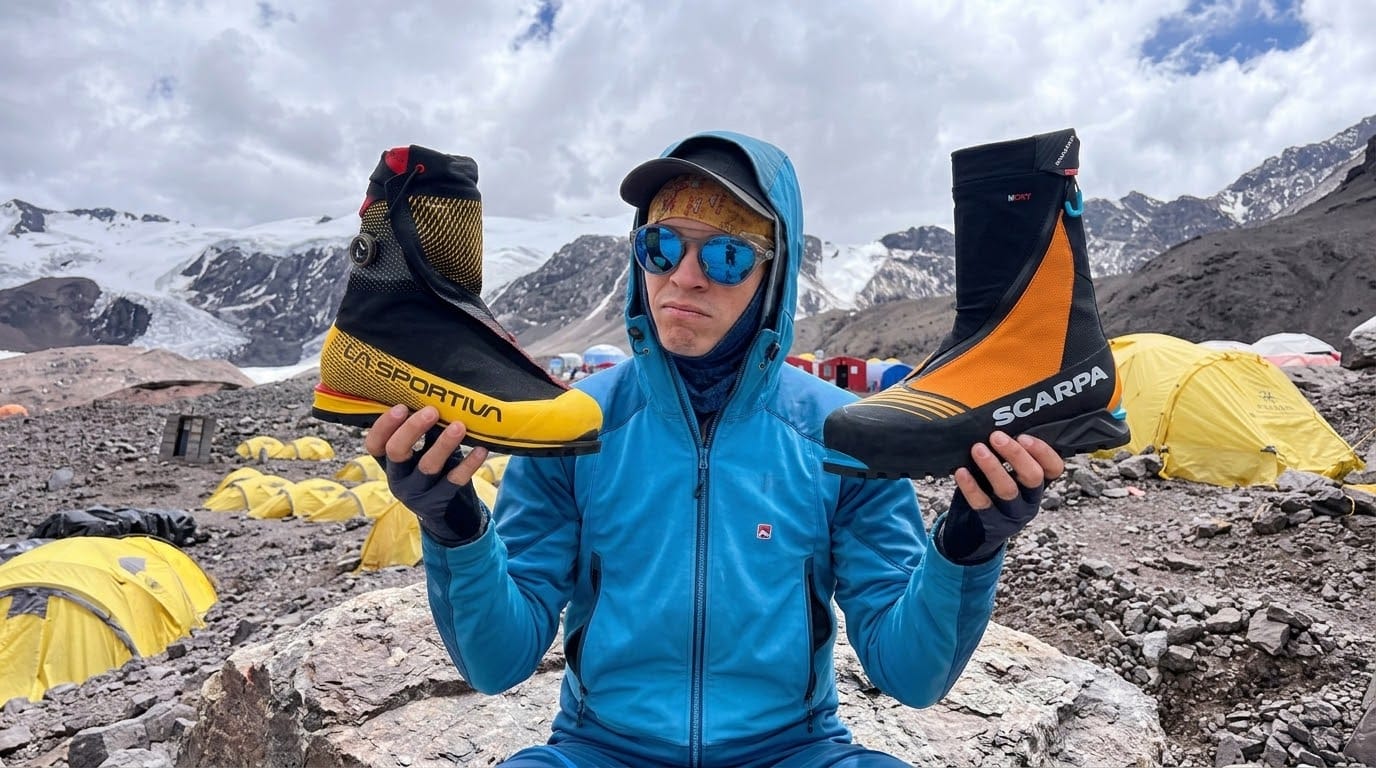
La Sportiva G2 Evo Vs Scarpa Phantom 6000 HD
Before giving you a general list of double boots, let's talk about the absolute favorites on Aconcagua: the La Sportiva G2 Evo and the Scarpa Phantom 6000 HD. These are the boots I see reaching the summit most often in recent years. Both are exceptionally high-performing double boots that offer optimal heat retention for these altitudes.
The most discussed difference between the two comes down to the closure system and the shape of the last. The G2 Evos stand out for their BOA fit system, which allows for quick, micro-adjustable tightening even while wearing thick gloves—a highly valued functional advantage over Scarpa's internal lacing system. Regarding the fit, although perceptions vary, the general consensus is that Scarpas tend to better accommodate wider feet, whereas the G2 Evos offer a generous interior volume that, for some climbers, can result in slight heel lift.
In my personal experience, I used the La Sportiva G2 Evos, but they caused me a lot of shin pain, probably because I have thicker calves. I was able to solve this by switching to the Scarpa Phantom 6000 HDs, as they turned out to be much more flexible around the cuff. Aside from that anatomical detail, I find them equally good in terms of overall features and thermal performance.
In conclusion, my recommendation is to base your final decision on your specific foot anatomy rather than technical specs, and always make sure to try on both models with the proper expedition socks.
List of double boots suitable for Aconcagua
- La Sportiva G2 Evo
- Scarpa Phantom 6000 HD
- La Sportiva Spantik
- Bestard Top extreme Lite
- Kayland K4 GTX
- Mammut Nordwand 6000 High
- Zamberlan 6000 Denali
- La Sportiva Baruntse
- Boreal G1 Lite
- The North Face Verto FA
- Scarpa Inverno
- Koflach Arctis Expe
Why not use La Sportiva Nepal or Scarpa Phantom Tech boots on Aconcagua?
It is very common, especially among climbers in my groups coming from Europe, to believe that single boots are enough. Being accustomed to technical snow and ice ascents at altitudes between 10,000 and 13,000 feet, many arrive in the Andes convinced that their go-to footwear will do the job. While it’s true you might hear stories of people managing to summit in this type of boot, these are purely anecdotal cases—climbers who got incredibly lucky and caught Aconcagua on an unusually warm and windless day.
My message here is blunt: do not risk your feet or toes getting severe frostbite. No matter how many exceptional success stories you’ve heard, you must always wear double boots on Aconcagua. To leave no room for doubt and to ensure you don’t put your expedition in jeopardy, below I am sharing a list of the types of footwear that are NOT suitable for this mountain (which mainly features single boots or single boots with integrated gaiters):
Boots NOT suitable for Aconcagua (they are not double boots)
- La Sportiva Nepal Evo gtx
- Scarpa Phantom Tech HD
- Salewa Pro Gaiter
- Salewa Ortles Couloir
- La Sportiva G5
- La Sportiva G Tech
- Simond Ice Evo
- La Sportiva Aequilibrium
La Sportiva G-Summit in Aconcagua
The La Sportiva G Summit is a boot I still hesitate to recommend. While it gets great reviews across the board and features a double-boot style inner liner, that liner is just too thin. If you are joining a group expedition, your overall pace will be slower, meaning you will need footwear that provides significantly more warmth. Therefore, I only suggest this boot for highly experienced climbers who know their bodies well and can maintain a fast enough pace to generate and retain body heat.
Don't have double boots? Where to rent footwear and gear in Mendoza
Boots you can rent in Mendoza
- La Sportiva G2 Evo
- La Sportiva Spantik
- Bestard Top extreme Lite
- La Sportiva Baruntse
- Scarpa Inverno
- Koflach Arctis
- Asolo AFS Ottomila (Asolo AFS 8000) NOT RECOMMENDED

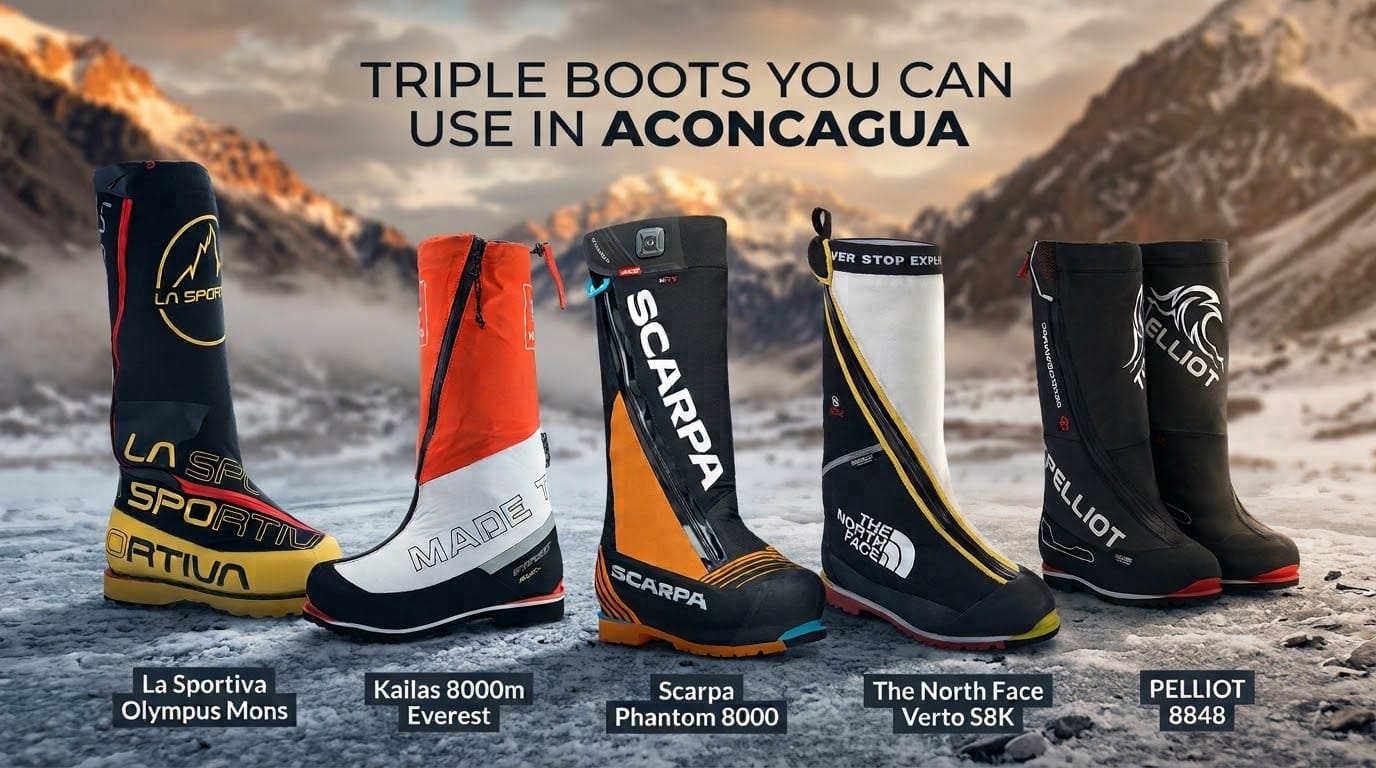
Triple boots on Aconcagua: Recommendations and essential care
I get it—you usually suffer from cold toes when heading to high altitudes, you want to make sure you don't have a miserable time, and now you're thinking about getting triple boots.
These are certainly an option for climbing Aconcagua, but they come with a few special considerations. Thanks to their higher integrated gaiters and superior insulation, they offer exceptional protection against extreme cold, helping to prevent frostbite in frigid conditions.
However, because of their added bulk and weight compared to double boots, they can significantly slow down your climbing pace. Furthermore, given Aconcagua's massive temperature swings, if the weather happens to be mild, triple boots can become excessively hot and uncomfortable during sunny days on the mountain or even on summit day.
List of triple boots you can use on Aconcagua
- Scarpa Phantom 8000
- La Sportiva Olympus Mons Cube
- PELLIOT 8848 alpine boots
- Kailas 8000m Everest
- Millet Everest Summit GTX
- The North Face Verto S8K
- Asolo Manaslu 8000
- Zamberlan 8000 Everest Evo RR
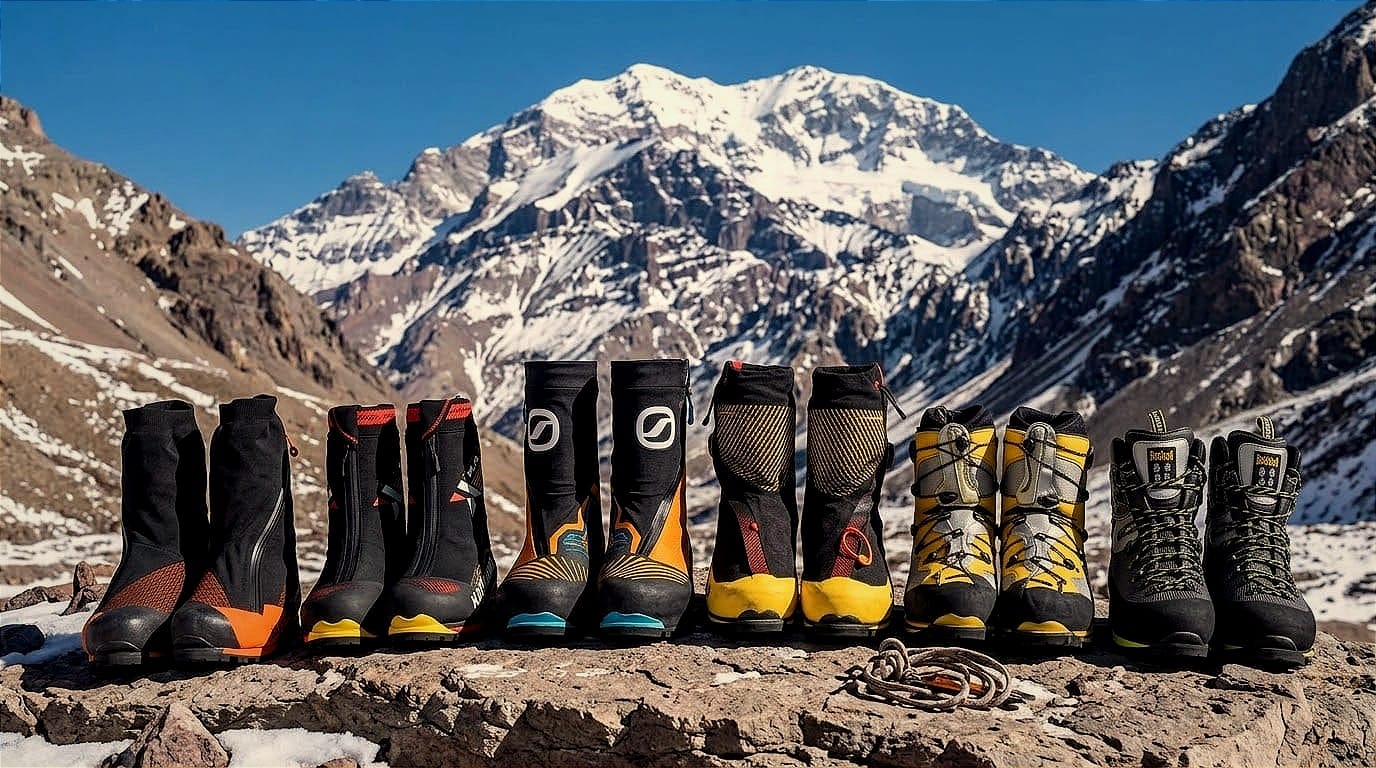
Frequently Asked Questions about double boots for Aconcagua
From which camp should I start using double boots on Aconcagua?
You don’t wear double boots from day one of the expedition. During the approach trek (whether heading to Plaza de Mulas or Plaza Argentina) and even on your first gear carries to the higher camps, your best bet is a sturdy pair of trail running shoes or lightweight hiking boots. If you wear your double boots at lower, warmer elevations, your feet will sweat excessively. This moisture will soak into the inner bootie, drastically increasing your risk of frostbite on summit day. Double boots should be reserved exclusively for the high camps.
As a guide, I sometimes see climbers who feel clumsy or uncomfortable in this type of footwear, and they’ll ask me: 'Julián, can I just save the boots for summit day only?' My answer is that, if you don't have prior experience with them, you need to start wearing them from Base Camp onwards. If you struggle to walk in them at lower altitudes, don't expect to magically do any better on summit day.
Can I walk around the campsites wearing only the inner boot?
I highly advise against this. While it’s tempting to just wear the inner booties for comfort around the tent, the terrain on Aconcagua is pure, highly abrasive rock. Walking outside the tent in just your liners will shred them in no time and completely ruin their insulation. For hanging out at base camp, you're much better off bringing dedicated camp footwear, like down booties with a durable sole, Crocs, or simply using your approach shoes.
As a quick anecdote, I once saw a climber wearing their inner booties with a pair of sandals strapped over them. I thought it was a brilliant and practical workaround to move around camp without trashing their gear.
Why don't you recommend double plastic boots (like the Asolo AFS 8000 or Koflach)?
Even though they were historically very popular and remain a budget-friendly option you'll frequently see in Mendoza's gear rental shops, they rely on outdated technology. They are significantly heavier, stiffer, and less warm than modern synthetic boots (like the La Sportiva G2 or Scarpa Phantom). If a tight budget forces you to rent them, I strongly advise pairing them with high-quality merino wool socks and chemical toe warmers—and you must be prepared for the fact that walking in them will take a much bigger physical toll on your body.
Are all crampons compatible with double boots?
Not necessarily. Because of the sheer bulk of double and triple boots, not every crampon will fit securely. It is absolutely vital that you test your boot and crampon system together before your trip—preferably using fully automatic or semi-automatic crampons. Make sure the bindings lock perfectly into the boot's welts and that the crampon is wide enough for the boot.
On our expeditions, we always do a preliminary gear check at base camp to ensure everyone's crampons are properly adjusted before heading up to the high camps. A pro tip: if the toe welt on your boot is heavily worn down, you are much better off using universal strap-on crampons to guarantee a secure fit and avoid any mid-climb issues.
How do I prevent the inner boots from freezing overnight at high-altitude camps?
The golden rule of high-altitude mountaineering is to sleep with your inner booties inside your sleeping bag. Your body heat will help dry out the moisture generated by the day's sweat and prevent you from waking up to stiff, frozen boots, which could seriously delay your early morning alpine start.
However, I actually advise doing this only on the night before summit day. On the days leading up to it, just make sure your boots are protected from the wind and snow. If it's snowing heavily, simply bringing them inside the tent is enough to solve the problem.
 Julian Kusi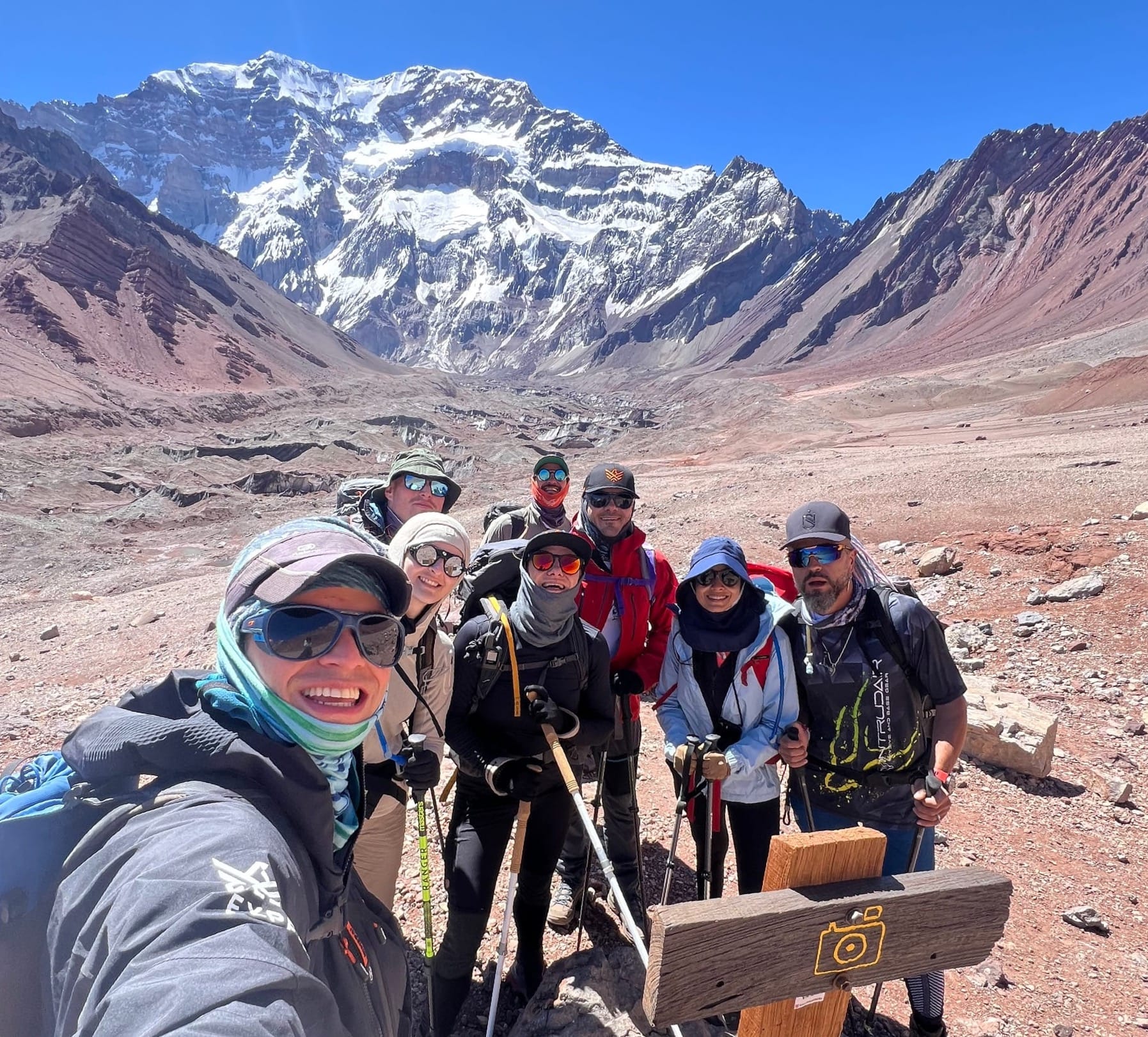
Remember that high-altitude evacuation insurance is mandatory to obtain your permit. I have complete confidence in Global Rescue and recommend them to my clients because of their proven track record in high-altitude situations.
Are you ready for Aconcagua?
Don't leave your expedition to chance. The mountain demands planning and the guidance of professionals who know its secrets. You can contact me directly for personalized advice through my official website.
About the author
Julián Kusi is a professional mountain guide with 17 summits on the "Stone Sentinel." Based in Mendoza, he specializes in the technical logistics and safety of the Normal and 360 routes on Aconcagua.
With a distinctly international and bilingual profile, Julián offers advice in Spanish, English, and Mandarin Chinese, facilitating access to the mountains for expeditions from around the world. His approach combines the precision of a high-altitude expert with modern logistical management, focused on maximizing the chances of reaching the summit for your next expedition.
Are you planning your next challenge? Connect with Julián for personalized advice and expedition availability on his Instagram: @julian_kusi or directly through aconcagua.co.